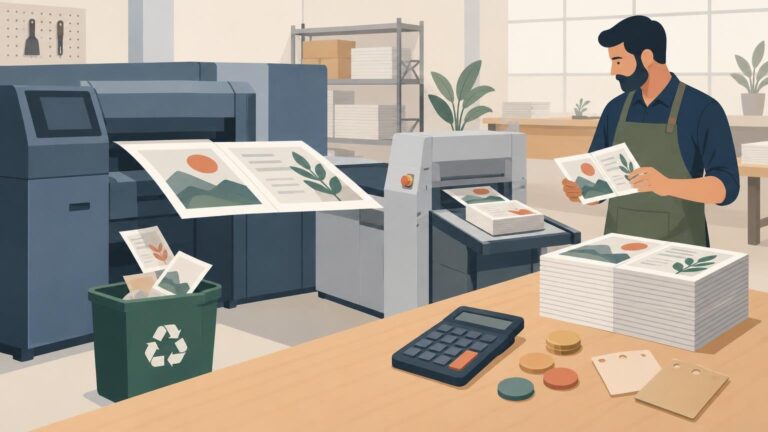
Running a print shop has a special talent: it can keep you busy all day and still leave you staring at the bank account like, “cool… where did it go?” If you’re chasing print shop profitability, you’re not alone. Most shops don’t have a “sales problem.” They have a small-leaks problem.
Speaking of Cents exists for that exact reason. We write guides and tips for printers and print shops who want more revenue, better margins, and fewer “we’ll fix it in post” moments. Real numbers, real workflows, and the stuff nobody teaches you when you buy your first press.
What we mean by print shop profitability
Print shop profitability is not just “raise prices” or “get more customers.” It’s the boring combo of:
Knowing your true costs (materials, labor, overhead, rework, spoilage, all of it)
Quoting in a way that doesn’t accidentally punish you for being good at your job
Building a workflow that produces sellable work, not just activity
Selling the work that your equipment is actually good at producing
Getting paid fast enough that you’re not financing everyone else’s business
And yes, it’s the cents-level details. The little things that quietly turn a “decent job” into a job you regret taking.
The profit leaks that usually hurt first
If you want a quick gut check, here are the usual suspects. These show up in almost every shop, from a one-person operation to a bigger commercial floor.
1) You’re estimating like it’s 2016
Old pricing tables don’t age well. Paper changes. Click charges change. Wages change. Your overhead definitely changes. And if you’re still quoting from a spreadsheet that hasn’t been updated in months, you can end up winning the job and losing money.
2) You’re not charging for the annoying parts
Odd quantities. Packing. Boxes. Labeling. Rush handling. Make-ready. Color matching. Small-run inefficiency. It’s easy to skip these because the customer doesn’t ask for them by name. But you still do the work.
3) Waste and rework are hiding in plain sight
Everyone talks about waste like it’s inevitable. Some waste is. But a lot of it is process. Overproduction, reruns, and “print it again, but this time the file is correct” can eat a week without looking dramatic.
4) You’re busy, but not with the right mix
Some jobs look good on paper until you factor in setup time, finishing time, approvals, and customer back-and-forth. The goal is not to be a shop that can do anything. The goal is to be a shop that makes money doing the things you do best.
Pricing that doesn’t sabotage you
Most print shops bounce between three pricing instincts:
Cost-plus: add a markup to your costs
Competitor-based: match the market
Value-based: price based on what the customer is really buying
All three show up in real life. The trick is knowing when each one makes sense.
Cost-plus is comforting because it feels “fair.” But it can quietly break as your business grows. Your cost structure shifts. Your pricing doesn’t always keep up. Competitor pricing can keep you in the ballpark, but it ignores what your shop is actually good at.
Value-based pricing gets a lot of eye rolls because it sounds like a seminar. But the core idea is simple: customers pay more when speed, consistency, service, and presentation matter. If you deliver those reliably, you can charge accordingly.
If we’re being honest, most of the pricing pain comes from not knowing your true costs. Which brings us to the most unsexy topic that fixes everything.
Job costing: the fastest way to stop guessing
If you only read one idea on this whole site, make it this: job costing is how you turn opinions into decisions.
You don’t need a fancy system on day one. But you do need a habit of capturing actuals:
What did the job really consume in materials?
How long did setup take?
How much operator time was involved?
Did finishing take longer than expected?
Did approvals slow it down?
Did you rerun anything?
Once you start collecting real numbers, you find patterns fast. Like “we always underbid small quantities,” or “this finishing step is a margin killer,” or “this customer’s files cost us more than they pay us for.”
A lot of shops avoid this because it feels like extra paperwork. But if your net margin is thin, you can’t afford mystery math. Print shop profitability loves boring visibility.
Workflow and throughput: less chaos, more capacity
Most shops don’t need more work. They need more clean capacity.
That usually means tightening a few specific areas:
Quoting speed and clarity
Slow quotes lose jobs. Confusing quotes lose trust. And sloppy quotes create scope creep. A quote should answer: what you’re making, when it ships, what’s included, and what costs extra.
Scheduling that respects bottlenecks
Every shop has a bottleneck. Sometimes it’s the press. Sometimes it’s cutting. Sometimes it’s packing because one person knows how the shipping software works. When you schedule like everything is equal, your bottleneck becomes your whole business.
Standard work for repeatable steps
This is where checklists stop being “corporate” and start being freedom. If the same problems keep happening, it’s usually because the process lives in someone’s head. Put it on paper. Make it the default.
Waste reduction that’s actually practical
Lean ideas sound like manufacturing cosplay until you apply them to printing, where waste shows up as waiting, overproduction, defects, and people walking around looking for the right stock. Cutting waste is often just cleaning up handoffs and making sure work doesn’t get “stuck” between steps.
Here’s a quick table to show what this looks like in real life:
Profit leak
What it looks like on the floor
What we fix first
Underestimated setup
Jobs “take longer than expected” every day
Setup standards + quoting templates
Overproduction
Extra stacks of overs everywhere
Stop rules + tighter spoilage targets
Hidden finishing time
Bindery eats the schedule
Time studies + minimum charges
Rework loops
“We’ll just rerun it”
File checks + proof workflow
Slow approvals
Jobs waiting for customer replies
Approval deadlines + clear proof steps
Product mix and finishing: where margins are hiding
Some of the best margin improvements don’t come from selling more units. They come from selling smarter work.
A few examples we cover on Speaking of Cents:
When finishing upsells make sense (lamination, UV coating, corner rounding, kitting)
When “rush” should be a premium, not a favor
How to bundle products so you sell outcomes, not line items
How to build price tiers that encourage better order sizes
This is also where you learn to respect your equipment economics. Ink cost per unit, cost per square foot, click charges, spoilage, and curing time all matter. If you price a job like it’s a commodity, you’ll get commodity margins.
Sales and retention: the money is in the second order
The easiest customer to sell to is the one who already trusts you.
Print shops often spend energy chasing new leads while ignoring simple retention wins:
Faster quote turnaround
Proactive reorder reminders for repeat items
Cleaner proofing
More predictable delivery windows
Clearer “here’s what you need to send us” file requirements
And yes, sometimes it’s just answering the phone like a human. A lot of print buyers don’t think printers make money anyway. They assume you can always cut price. Part of profitability is teaching customers that good print has value.
Cash flow: stop financing other people’s projects
You can be profitable on paper and still feel broke if cash comes in late.
This site will cover practical cash flow moves like:
Deposits for custom work
Payment terms that match your risk
Clear policies on proofs and changes
Charging for rush and revisions
Tight invoicing habits so billing doesn’t lag behind production
Not glamorous. Very effective.
What you’ll find on Speaking of Cents
Speaking of Cents is built as a working library for print shop profitability. Expect:
Pricing and estimating guides (including quoting templates and minimums)
Job costing and margin tracking basics (simple first, deeper later)
Workflow and production tips (bottlenecks, scheduling, standard work)
Waste and rework reduction (without pretending mistakes don’t happen)
Sales and retention tactics that fit print buyers
Tool-style content: calculators, checklists, and “use this today” frameworks
And when something’s complicated, we’ll say that too. Printing is not a clean little spreadsheet business. It’s messy. That’s fine. We just want you making money while you’re doing it.
Start here: five moves that usually pay off fast
If you’re new to the site, here’s the order I’d tackle first:
Audit your last 20 jobs for “what surprised us”
Update your estimating standards for setup and spoilage
Add charges for the extras you always do anyway
Identify your real bottleneck and protect it with scheduling
Set one simple job-costing habit (even if it’s just tracking time and reruns)
Do that, and print shop profitability stops being a vibe and starts being a system.
Final thought
Speaking of Cents is for printers who are done guessing. If you want clearer pricing, tighter operations, and fewer painful jobs that “seemed fine at the time,” you’re in the right place.
Because the goal is simple: you deserve a shop that pays you back.
Calculate a defensible minimum order charge from pre-production labor, minimum production costs and required contribution, with examples for custom jobs and reorders.
A worked cost bridge for converting duplex click charges into the direct cost of a sellable printed piece, including imposition, stock, waste and finishing.
A print product should not be discontinued merely because allocated overhead makes it look unprofitable. Use contribution, avoidable costs, capacity value and customer effects to decide whether to raise the price, simplify, outsource or exit.
A calculator-led method for measuring paid, organic and referral acquisition costs, then comparing CAC with the contribution each new customer produces.
Editable design files can transfer future production capability, create handoff work and change support expectations. Use this model to scope and price them properly.